What is All Back Contact Solar Cells – Working & Benefits
Published: 7 Nov 2025
Ever wondered why some solar panels look smoother and work better than others? Many people notice the difference but don’t know what makes it happen. That’s where all back-contact solar cells come into the picture. This guide will clear your confusion by showing how this design changes the way solar panels collect light, improves efficiency, and looks more modern. We’ll walk through how they work, what makes them unique, and why they are becoming popular among solar users and professionals alike.
What Is All Back Contact Solar Cells?
All back contact solar cells are a type of solar technology where all the electrical connections are placed on the back side of the cell. This design removes the metal lines from the front, allowing more sunlight to reach the active surface. The term “all back contact” simply means that both the positive and negative contacts are located behind the cell. It is often shortened to ABC solar cell.
This setup improves light absorption and gives the panel a clean, dark look. Unlike traditional cells, there are no visible silver lines on the top surface. The result is higher power output and better performance under real sunlight. This technology is now used in many premium solar panels that focus on both beauty and efficiency.
How All Back Contact Solar Cells Work
How it works when all electrical contacts sit on the back is simple to picture. First, the front of the cell stays clear because no metal lines cross it. Sunlight falls on the clean front surface. The silicon layer absorbs the light. Photons in light knock electrons free inside the silicon. An electric field in the cell pushes electrons one way and holes the other way.
The free electrons move to the back contacts. Those back contacts collect the electrons and send them as an electric current to the panel wires. Think of it like a window with no bars — more light gets in and the room stays bright. This setup helps the cell make more power and keeps the panel looking neat.
Structure and Design of All Back Contact Solar Cells
All back-contact solar cells have a simple but smart design. The top layer is clean silicon that catches sunlight. There are no metal lines or busbars on the front, so light can enter freely. Just under this layer, the silicon absorbs energy and creates an electrical charge. On the back side, tiny metal contacts and busbars are neatly arranged to collect that charge. These contacts are set in a pattern that keeps them from touching each other, helping the current move smoothly.
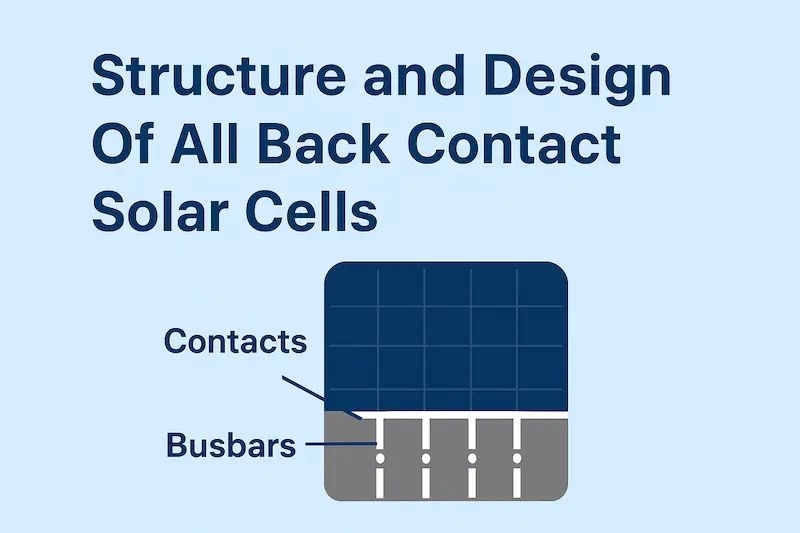
You can imagine the difference like two windows. A front contact cell is like a window with thin metal bars that block a bit of light. An all-back contact cell is like a clear window with no bars, so all the sunlight passes through. This simple change in structure makes the panel more efficient and gives it a sleek, modern look.
Types of All Back Contact Solar Cells
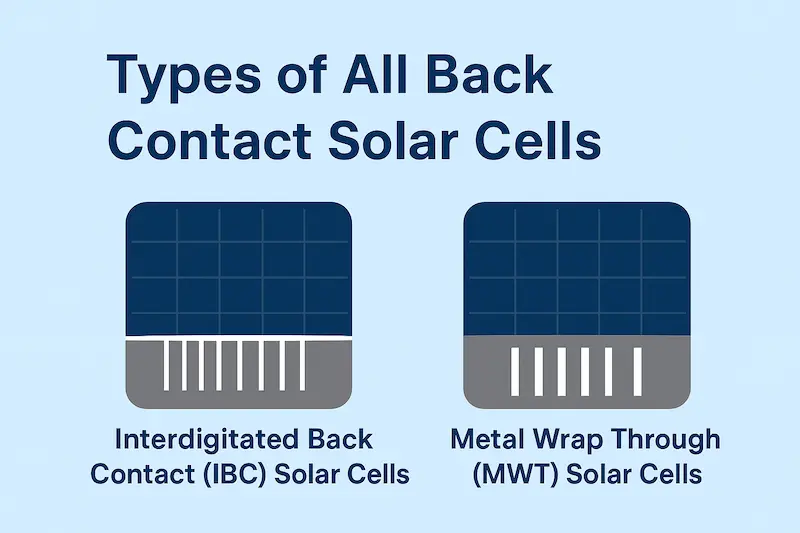
All back contact solar cells come in different designs, each made to boost power output and cut energy loss. The two main types are Interdigitated Back Contact (IBC) and Metal Wrap Through (MWT) cells. Both move electrical contacts to the back, but they do it in slightly different ways to improve sunlight capture and performance.
- Interdigitated Back Contact (IBC) Solar Cells
- Metal Wrap Through (MWT) Solar Cells
Interdigitated Back Contact (IBC) Solar Cells
Interdigitated Back Contact solar cells, also called IBC cells, are one of the most advanced types of all back contact designs. In these cells, both positive and negative contacts are placed on the back in a fine, finger-like pattern. This setup keeps the front surface clean, allowing sunlight to reach the silicon without any blockage.
The current moves through these tiny back contacts to create electricity more efficiently. Because of this smart design, IBC cells often show very high efficiency. They are used in premium solar panels made by brands like SunPower, which are known for strong performance and long life.
Metal Wrap Through (MWT) Solar Cells
Metal Wrap Through solar cells, or MWT cells, are another type of back contact design. They use small holes in the silicon to move the front contact connections to the back. This keeps most of the front surface clear while still allowing a simpler design than IBC. The main benefit is reduced shading on the front side, allowing more sunlight to be absorbed.
MWT cells are slightly easier to make than IBC and still help reduce power loss caused by metal lines on the front. Both types aim to make solar panels cleaner in appearance and stronger in output.
Key Features and Benefits
All back-contact solar cells come with features that make them stand out from regular solar cells. Their design focuses on getting more light, better power output, and a smooth appearance. These benefits make them a smart choice for homes and projects that value both performance and style.
Key Features and Benefits:
- No metal lines on the front, so the cell absorbs more sunlight.
- Works better in partial shade since light is used more efficiently.
- Has a clean, uniform black look that gives panels a modern finish.
- Produces higher efficiency and reduces power loss during use.
- Operates at a lower temperature, which helps maintain steady performance.
All Back Contact vs Conventional Solar Cells
All back contact solar cells and conventional solar cells both make electricity from sunlight, but they do it in slightly different ways. The main difference is in where the electrical contacts are placed and how much sunlight the cell can use. This design change affects how they look, how much energy they make, and how long they last.
Here’s a simple comparison:
| Feature | All Back Contact (ABC) Solar Cells | Conventional Solar Cells |
| Efficiency | Higher, as all light hits the active surface | Slightly lower due to front metal lines blocking light |
| Appearance | Smooth, black, and uniform | Visible silver lines and grid pattern |
| Shading Losses | Very low, since no front wires | Higher, due to front-side metal lines |
| Cost | More expensive to produce | Less costly and widely available |
| Durability | Long lifespan with stable performance | Reliable, but can degrade slightly faster |
| Technology Level | Advanced design for premium systems | Standard design for general use |
ABC solar cells are seen as next-generation technology because they combine better looks with improved performance. By removing front contacts, they use light more efficiently and give panels a modern, clean look. As production methods improve, these cells are becoming more common in high-efficiency solar products.
Applications and Uses
All back-contact solar cells are used in many types of solar setups where both high power and good design matter. Their smooth surface and high efficiency make them a popular choice for modern solar projects. These cells are often found in systems that focus on clean looks and strong performance over time.
Common applications include:
Home rooftops: Perfect for homeowners who want neat, dark panels that blend well with the roof.
Commercial buildings: Used in offices and business sites where energy output and appearance both matter.
Premium solar systems: Chosen for projects that need top efficiency, long life, and modern design.
ABC solar cells are ideal for people who want reliable power without giving up on style. They work well for anyone who values both performance and a clean, professional look.
Efficiency and Performance
All back-contact solar cells are known for their high efficiency and steady performance. Modern ABC solar cells can reach an efficiency of around 22% to 24%, which is higher than most standard panels. This means they can turn more sunlight into electricity using the same amount of space.
Their performance depends on a few key factors. The quality of the silicon and contact design plays a big role in how much power they produce. Temperature also affects them — cooler conditions usually help them work better. Light quality matters too; they perform best in bright, direct sunlight.
Well-known technologies like SunPower Maxeon and LONGi ABC modules use this design to achieve strong results in both homes and businesses. These panels are built to last longer, handle heat better, and keep power loss low. Because of this, ABC solar cells are often used in systems that need high reliability and top efficiency all year round.
Limitations and Challenges
Even though all back-contact solar cells offer many benefits, they also come with a few challenges. These issues mainly relate to how they are made and how much they cost.
Main limitations and challenges:
Higher cost: The materials and design are more advanced, so making these cells costs more than standard ones.
Complex production: The process of placing all contacts on the back is difficult and needs special tools and skills.
Limited large-scale use: Because of the higher cost and complex setup, ABC solar cells are still not widely used in every market.
As technology improves, these challenges are slowly being solved. Many solar companies are now working to make production cheaper and faster so more people can use this advanced design.
Future of All Back Contact Solar Cells
The future of all back-contact solar cells looks very bright. Researchers are working to make this technology more efficient and less costly to produce. New designs aim to improve energy yield by using better-quality silicon and advanced contact patterns. These upgrades help the cells capture more sunlight and lose less power as heat.
Manufacturers are also finding ways to simplify production, which will make ABC panels more affordable in the coming years. Companies like LONGi and SunPower are already leading research in this field, pushing for higher output with lower material use.
As the world moves toward cleaner energy, ABC solar cells fit perfectly into the goal of sustainable innovation. They combine smart engineering with eco-friendly design, helping solar energy become stronger, smarter, and more accessible for everyone.
Final Thoughts
All back contact solar cells show how solar technology keeps getting better. In this guide, you learned what they are, how they work, and why their design helps panels produce more power while looking cleaner. We also covered their structure, types, benefits, and the small challenges they still face.
When choosing a solar panel, think about your energy needs, space, and budget. ABC solar cells are a great choice if you want high efficiency and a modern design that lasts for years.
To make a smart solar decision, you can also read our other helpful guides:
Solar Panels Complete Lifespan Guide
Net Meter vs Gross Meter Comparison
Learning about these topics will help you understand your solar setup better and get the best results from your investment.


- Be Respectful
- Stay Relevant
- Stay Positive
- True Feedback
- Encourage Discussion
- Avoid Spamming
- No Fake News
- Don't Copy-Paste
- No Personal Attacks
- Be Respectful
- Stay Relevant
- Stay Positive
- True Feedback
- Encourage Discussion
- Avoid Spamming
- No Fake News
- Don't Copy-Paste
- No Personal Attacks
