What Are Perovskite Solar Cells? A Simple Guide for Beginners
Published: 17 Dec 2025
Solar energy technology is advancing rapidly, and one of the most talked-about innovations today is the perovskite solar cell. Scientists, energy experts, and even major solar companies believe this technology could change how we generate clean electricity.
This article explains perovskite solar cells in simple, clear, and easy-to-understand English—no technical background required.
What Are Perovskite Solar Cells?
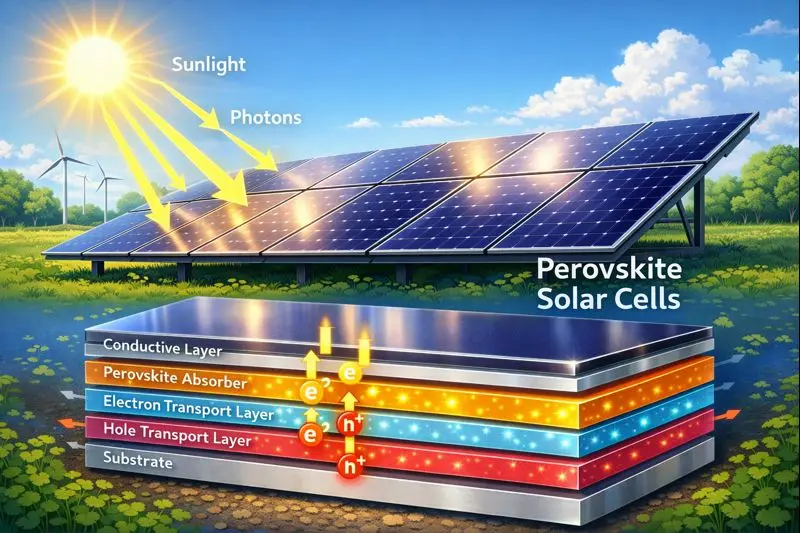
Perovskite solar cells are a new type of solar cell that uses a special material called perovskite to convert sunlight into electricity.
Instead of using only silicon (as traditional solar panels do), these cells use a perovskite crystal structure that absorbs sunlight extremely well.
In simple words:
Perovskite solar cells are lighter, cheaper, and potentially more efficient than traditional solar cells.
What Does “Perovskite” Mean?
Perovskite is not one single material.
It describes a crystal structure that can be made from different chemical combinations.
This structure allows the material to:
- Absorb more sunlight
- Convert light into electricity more efficiently
- It can be produced at lower temperatures
That’s why perovskite solar cell technology is considered next-generation solar technology.
How Do Perovskite Solar Cells Work?
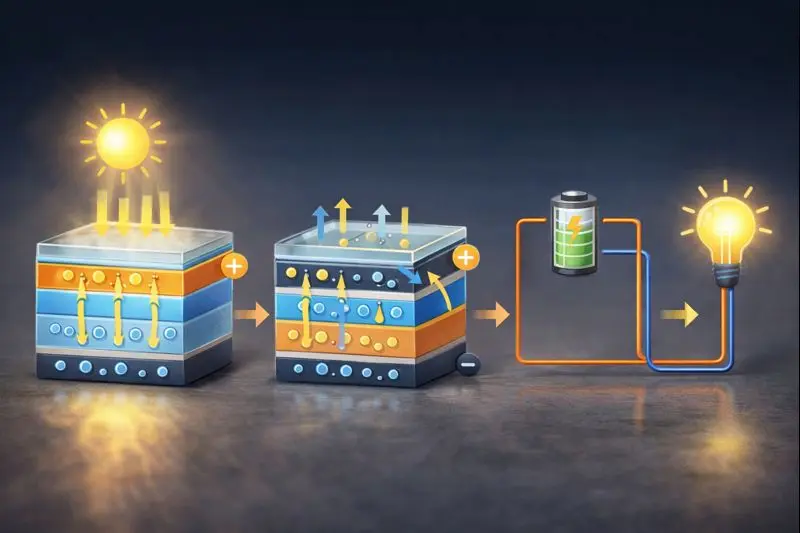
Perovskite solar cells work in a way similar to regular solar cells:
- Sunlight hits the perovskite layer
- The material absorbs light very efficiently
- Electrons are released
- These electrons flow through a circuit
- Electricity is produced
The key difference:
Perovskite materials absorb sunlight better than silicon, even in low-light conditions.
Why Are Perovskite Solar Cells Important?
Perovskite solar cells are significant because they can address some major issues of traditional solar panels.
They offer:
- Higher efficiency
- Lower production costs
- Flexible and lightweight designs
- Better performance in cloudy or indoor light
This makes them a strong candidate for the future of solar energy.
Advantages of Perovskite Solar Cells
Here are the main advantages explained:
✅ High Efficiency
Perovskite solar cells have reached over 25% efficiency in labs—and tandem versions can exceed 30%.
✅ Lower Cost
They can be manufactured using cheaper materials and simpler processes compared to silicon.
✅ Lightweight & Flexible
One of the biggest advantages of perovskite solar cells is their flexibility.
Unlike traditional silicon panels, perovskite layers can be applied to thin, bendable surfaces.
This makes them ideal for windows, curved buildings, and wearable technology.
Learn more about this technology in our detailed guide on flexible solar panels
Perovskite layers are thin and can be applied to:
- Flexible panels
- Windows
- Curved surfaces
✅ Works in Low Light
They perform better than silicon in:
- Cloudy weather
- Early morning or evening light
- Indoor conditions
Disadvantages of Perovskite Solar Cells
Despite their promise, perovskite solar cells still face challenges:
❌ Stability Issues
They can degrade faster when exposed to:
- Heat
- Moisture
- UV radiation
❌ Shorter Lifespan
Silicon panels last 25–30 years.
Perovskite cells currently have a much shorter lifespan.
❌ Lead Content
Many perovskite materials contain lead, raising environmental concerns (though recycling solutions are being developed).
Perovskite Solar Cells vs Silicon Solar Cells
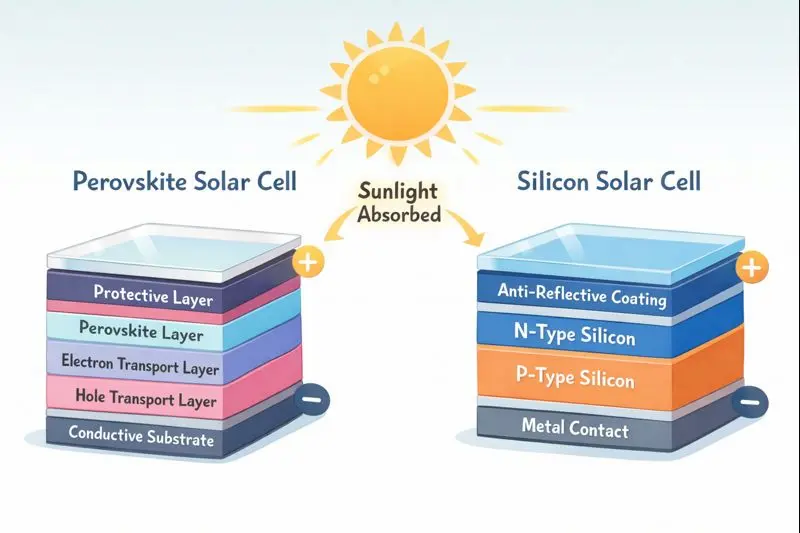
Here is a table in which you can see a comparison between perovskite solar cells and silicon solar cells in different features like efficiency, cost, weight, flexibility, lifespan, and commercial use.
| Feature | Perovskite Solar Cells | Silicon Solar Cells |
| Efficiency | Very high (25–30%+) | High (20–22%) |
| Cost | Lower (potentially) | Higher |
| Weight | Lightweight | Heavy |
| Flexibility | Flexible | Rigid |
| Lifespan | Shorter (for now) | 25–30 years |
| Commercial Use | Limited | Widely used |
Bottom line:
Perovskite solar cells are not replacing silicon yet—but they may soon work together.
What Are Tandem Solar Cells?
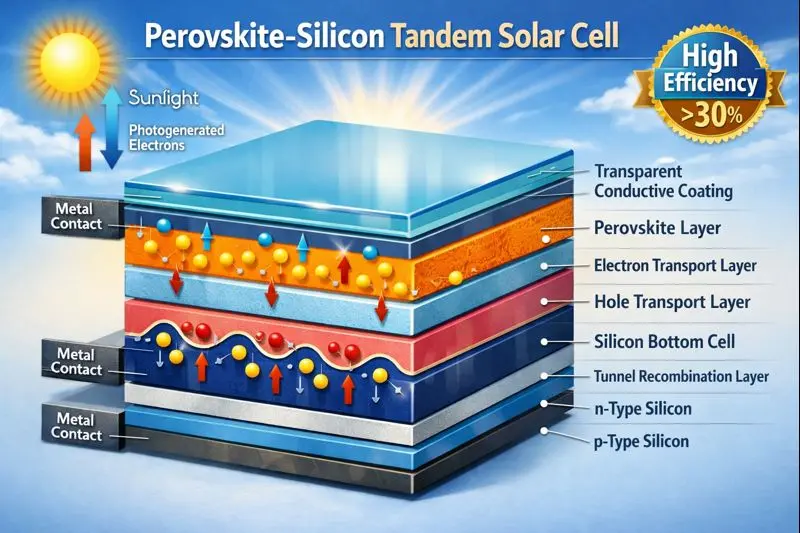
Tandem solar cells combine:
- Perovskite layer + silicon layer
This allows the panel to capture more parts of sunlight, dramatically increasing efficiency.
Many experts believe perovskite-silicon tandem solar cells are the future of commercial solar panels.
Efficiency of Perovskite Solar Cells
- Lab efficiency: 25–30%+
- Tandem cells: 30–33%
- Traditional silicon: 20–22%
This efficiency advantage is why perovskite solar cells are considered a breakthrough in solar technology.
Are Perovskite Solar Panels Available Today?
At the moment:
- Limited commercial products exist
- Mostly used in research and pilot projects
However, major companies are working to bring them to market within the next few years.
When Will Perovskite Solar Cells Be Commercially Available?
Experts predict:
- Small-scale products: very soon
- Large rooftop & utility panels: within 3–5 years
As durability improves, mass adoption will follow.
Are Perovskite Solar Cells Safe?
The main concern is lead content.
However:
- The amount of lead is small
- Recycling systems are being developed
- New lead-free perovskite materials are under research
Overall, experts believe risks can be managed safely.
Future of Perovskite Solar Cells
The future looks very promising.
Perovskite solar cells could:
- Reduce solar energy costs globally
- Enable solar windows and building-integrated panels
- Make solar power more accessible
- Help accelerate the transition to clean energy
They are widely seen as one of the most important renewable energy innovations today.
FAQs About Perovskite Solar Cells (People Also Ask)
These frequently asked questions cover what perovskite solar cells are, how they work, and when they may become widely available.
Perovskite solar cells are a new type of solar cell that uses a perovskite material layer to turn sunlight into electricity. They can be lighter, cheaper, and potentially more efficient than traditional silicon solar cells.
In lab tests, perovskite solar cells can reach higher efficiency than standard silicon cells. However, silicon is still better for long-term durability and real-world lifespan, which is why perovskite is not replacing silicon yet.
The biggest challenge is stability. Perovskite materials can degrade faster when exposed to moisture, heat, and UV light, which can shorten the lifespan compared to silicon panels.
Perovskite solar cells have achieved about 25%+ efficiency in laboratories, and perovskite–silicon tandem cells can exceed 30%. Standard commercial silicon panels are usually around 20–22% efficient.
Availability is still limited. Some early commercial products and pilot projects exist, but most perovskite solar panels are still in the research and scaling phase.
Small-scale products are expected first, while large rooftop and utility-scale panels are commonly predicted within the next 3–5 years, depending on durability improvements and manufacturing scale-up.
Tandem solar cells stack two materials—often a perovskite layer on top of a silicon layer—so the panel can capture more of the sunlight spectrum. This is one of the main ways solar efficiency can go beyond what silicon alone can achieve.
Perovskite materials absorb light strongly and can perform well even when sunlight is weaker, such as on cloudy days, mornings/evenings, or indoors—often better than silicon in these conditions.
Final Thoughts
Perovskite solar cells explained simply:
They are a powerful new solar technology that could make solar energy cheaper, lighter, and more efficient.
While challenges remain, ongoing research and investment suggest that perovskite solar cells may shape the future of solar power.






- Be Respectful
- Stay Relevant
- Stay Positive
- True Feedback
- Encourage Discussion
- Avoid Spamming
- No Fake News
- Don't Copy-Paste
- No Personal Attacks
- Be Respectful
- Stay Relevant
- Stay Positive
- True Feedback
- Encourage Discussion
- Avoid Spamming
- No Fake News
- Don't Copy-Paste
- No Personal Attacks
