How Much Do Solar Panels Really Save You in 2026? (Cost, Payback & Rebates)
Published: 22 Jan 2026
I could not tell if solar would cut my bills or just add work and cost. This guide shows clear costs, simple payback math, and the rebates you can claim in 2026. You will get easy steps to estimate your savings. You will see example numbers for small and large homes. You will learn how rebates and net metering lower your net cost. Use this guide to make a steady decision about solar for your home.

What is Solar Savings: Cost, Payback Time, and Government Rebates
How Much Do Solar Panels Really Save You in 2026? asks how much money a homeowner keeps after they install solar panels. It covers the full cost of the system, including panels, inverters, and installation. It counts rebates, tax credits, and net metering that lower the net price. It measures the yearly drop in your electric bill after the system goes live. It shows how many years it takes for your savings to equal the net cost. It looks at local factors like roof direction, sun hours, and electricity rates. It helps a homeowner decide if solar makes sense for their home and budget.
2026 Solar Panel Costs (Quick Summary)
Most home systems range from 4 kW to 10 kW.
Smaller homes often use 4–6 kW. Larger homes use 8–10 kW.
Typical prices before incentives:
4 kW: $10,000 to $14,000
6 kW: $15,000 to $20,000
8 kW: $20,000 to $28,000
10 kW: $25,000 to $35,000
Installed cost includes panels, inverters, wiring, racking, and labor. The upfront price may show only hardware. Installed cost adds permits, labor, and inspection fees. Ask installers for a fully installed quote to see the real total.
How to Calculate Your Savings (Step-by-step)
1. Find yearly kWh use
- Look at your electric bills for one year.
- Add the kWh numbers. That total is your yearly use.
2. Estimate system size needed
- Divide your yearly kWh by 1,200.
- The result gives a rough kW size.
- Round up to the next whole number for safety.
3. Estimate system cost before incentives
- Multiply system size (kW) by the local price per kW.
- Use $2,500 to $3,500 per kW as a current range.
- This gives the pre-incentive cost.
4. Subtract rebates and tax credits
- Find federal and local credits or rebates.
- Subtract their dollar value from the pre-incentive cost.
- The result is your net cost.
5. Compute annual bill savings and payback years
- Multiply the yearly kWh you offset by your local rate per kWh to get your annual savings.
- Payback years = Net cost ÷ Annual savings.
- Compare payback years to system lifespan (25–30 years) to see long-term value.
Example Calculations (Two Simple Cases)
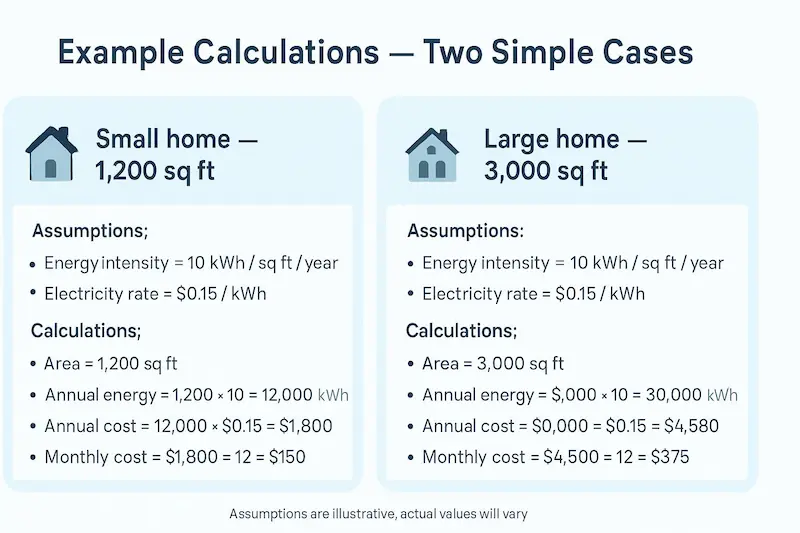
Small home example
- Yearly use: 6,000 kWh.
- Estimated system size: 6,000 ÷ 1,200 = 5 kW (round to 5 kW).
- Pre-incentive cost: 5 kW × $3,000 = $15,000.
- Incentives: federal credit of $3,000. Net cost = $12,000.
- Annual savings: 6,000 kWh × $0.15 = $900.
- Payback years: $12,000 ÷ $900 ≈ 13 years.
- Note: System life of 25 years gives about 12 years of net savings after payback.
Large home example
- Yearly use: 18,000 kWh.
- Estimated system size: 18,000 ÷ 1,200 = 15 kW (round to 15 kW).
- Pre-incentive cost: 15 kW × $2,800 = $42,000.
- Incentives: federal credit of $8,400. Net cost = $33,600.
- Annual savings: 18,000 kWh × $0.18 = $3,240.
- Payback years: $33,600 ÷ $3,240 ≈ 10.4 years.
Note: Higher electricity rates and net metering can cut payback time further.
Government Rebates and Incentives in 2026
Federal tax credits overview
The federal solar tax credit reduces the tax you owe. You can claim a percentage of the system cost on your federal tax return. The credit lowers your net cost by thousands of dollars for many homeowners. Check current IRS rules or your tax advisor to confirm the exact percent for 2026.
Typical local rebates and net metering notes
Many states and utilities offer cash rebates or performance payments. Local rebates can cut the upfront cost by a few hundred to several thousand dollars. net metering lets your meter run backward when you send extra power to the grid. Net metering credits reduce your electric bill and increase annual savings. Some utilities use time-of-use or export rates instead of full net metering, so credit values can vary.
How to find local programs
Visit your state energy office website for statewide incentives. Check your utility company’s solar or rebate page. Use official government sites that list incentives for homes. Ask local installers for current rebate details. Keep printed copies of program rules and deadlines when you apply.
Factors That Change Savings
Sunlight and roof orientation
South-facing roofs get more sun in many places. More sun means more energy and more savings. Steep roofs can catch more light than flat roofs.
Shading and roof condition
Trees or nearby buildings can block the sun. Shade cuts panel output. A worn roof may need repair before installation. Installers check roof health first.
Panel efficiency and inverter costs
Higher-efficiency panels make more power from the same roof area. They cost more but can raise savings. Inverters convert DC to AC. Good inverters last longer, but add to the upfront cost.
Local electricity rates
Higher local rates raise your annual savings. If your utility charges more cents per kWh, solar offsets more cost. Watch for rate changes or time-of-use pricing that affect value.
Maintenance, Warranties, and Lifespan
Typical maintenance tasks
- Clean the panels once or twice a year if dust or leaves accumulate.
- Trim nearby trees to keep panels in the sun.
- Check for loose wires or damage after storms.
- Have an installer inspect the system every few years.
For readers who want more on panel tech, read the all-back-contact solar cells guide to learn how newer cells boost efficiency and save roof space. To plan long-term savings, refer to the solar panel lifespan guide for clear timelines on performance, warranties, and expected replacement intervals.
Warranty types and expected replacements
- Panel warranties often cover power output for 25 years.
- The manufacturer’s warranty covers defects for 10–25 years.
- Inverter warranties usually last 10–15 years.
- You may replace the inverter once in the system’s life.
- Keep warranty papers and service records for any claims.
Pros and Cons
Clear side-by-side list of benefits and drawbacks
| Pros | Cons |
| Lower electric bills | High upfront cost |
| Reduce carbon footprint | Payback can take 10+ years |
| Increase home value | A roof or shade can limit output |
| Fixed energy cost against rising rates | The inverter may need replacement |
| Low annual maintenance | Savings vary by location and rates |
Quick Step-by-Step Checklist to Buy Solar
1. Inspect the roof and energy use
Check roof age, slope, and damage.
Add up one year of kWh from your bills.
2. Get quotes and compare offers
Request at least three quotes from local installers.
Compare system size, equipment, warranties, and total installed price.
3. Check incentives and financing
Confirm federal and local rebates and tax credits.
Ask about loans, leases, and PPA options.
Calculate net cost after incentives.
4. Sign the contract and schedule the installation
Read the warranty and performance terms.
Confirm permit and inspection responsibilities.
Set an install date and keep contact info for the crew.
Conclusion—Next Steps to Estimate Your Savings
Use your last year of electric bills to find yearly kWh, then divide that number by 1,200 to estimate the kW system you need. Multiply the kW by $2,500–$3,500 to get a pre-incentive cost, and subtract federal and local rebates to find your net cost. Multiply your yearly kWh by your local $/kWh to find annual savings, then divide the net cost by annual savings to get payback years. Get three installer quotes, compare equipment and warranties, and choose the best net cost. This simple process will give you a clear estimate of how much solar can save you in 2026 and help you decide if a system fits your budget and home.



- Be Respectful
- Stay Relevant
- Stay Positive
- True Feedback
- Encourage Discussion
- Avoid Spamming
- No Fake News
- Don't Copy-Paste
- No Personal Attacks
- Be Respectful
- Stay Relevant
- Stay Positive
- True Feedback
- Encourage Discussion
- Avoid Spamming
- No Fake News
- Don't Copy-Paste
- No Personal Attacks
