Smart Energy Management: How Technology Can Reduce Household Energy Consumption
Published: 15 Oct 2026
A household electricity bill shows how much power was consumed but rarely explains which appliances caused an unexpected increase. An air conditioner may have run longer than necessary, a water heater may have operated during expensive hours, or several electronics may have continued drawing power while nobody was using them.
Smart energy management helps identify and address such patterns. By combining energy monitoring, connected devices, and automatic controls, households can make informed decisions about when and how electricity is used. The process does not require turning every appliance into a smart device. The better starting point is to identify where energy is being wasted, choose a suitable technology, and measure whether the change produces a real improvement.
What Is Smart Energy Management?
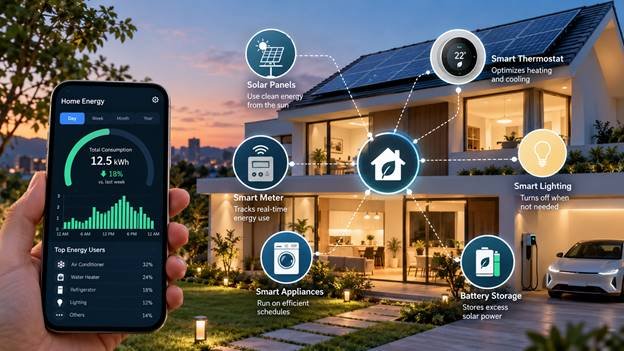
smart energy management is the process of monitoring and controlling household energy use through connected devices, software, and automated settings. Depending on the equipment installed, a system may track electricity consumption, adjust room temperatures, switch off unused lights, or coordinate appliances with available solar power.
Three functions make the system useful:
- Monitoring: Smart meters, energy monitors, and connected appliances provide information about how much electricity is being used.
- Control: Smart plugs, thermostats, switches, and appliance apps allow users to change operating times or settings.
- Automation: Schedules, occupancy sensors, and energy-management software carry out selected actions without requiring someone to operate every device manually.
A home energy management system (HEMS) brings several of these functions together. It can help coordinate household consumption with electricity prices, rooftop solar generation, or battery storage when the relevant equipment and services are compatible.
The purpose is straightforward: use electricity when it is needed, avoid unnecessary operation, and maintain comfortable living conditions without wasting power.
Which Technologies Can Reduce Household Energy Consumption?
Different devices address different sources of energy waste. The right choice depends on the appliances in use, household routines, and the information already available through the electricity provider.
| Technology | How it helps | What households should check |
| Smart meter and utility app | Shows household electricity consumption, sometimes at short intervals, making changes in usage easier to identify | How frequently readings update and whether the provider offers detailed usage data |
| Plug-in energy monitor or smart plug | Measures or reports the consumption of compatible connected appliances and can schedule their operation | Whether energy measurement is supported and the device is rated for the connected load |
| Smart thermostat | Adjusts heating or cooling schedules according to occupancy, temperature, and user preferences | Compatibility with the heating or cooling equipment and suitability of the proposed schedule |
| Smart lighting and occupancy sensors | Turns lights off when rooms are unoccupied or adjusts lighting according to a schedule | Whether existing bulbs, switches, and sensors can work together |
| Connected appliances | Allows users to monitor appliance status, select operating schedules, or use energy-saving modes | Whether the connected features reduce actual consumption rather than simply offer remote control |
| Home energy management system | Coordinates supported devices, solar generation, storage, and energy-use information through one interface | Device compatibility, tariff availability, privacy controls, and total installation cost |
A smart meter and a plug-in energy monitor serve different purposes. A smart meter measures electricity use across the household at the utility connection, while a plug-in monitor can provide information about an individual compatible appliance. Depending on the equipment and service, neither necessarily provides instant readings for every circuit or device.
Smart Thermostats: Focus on Heating and Cooling
Heating and cooling can account for a substantial portion of a household’s energy expenditure. Smart thermostats help manage this demand by following occupancy schedules, responding to temperature conditions, and adjusting settings when full heating or cooling is unnecessary.
For example, a household that leaves for work every morning can set the thermostat to avoid maintaining the same temperature throughout an empty house. A suitable comfort setting can resume before residents return.
According to ENERGY STAR’s smart thermostat guidance, certified smart thermostats save approximately 8% of heating and cooling bills, or about USD 50 per year on average in the United States. Actual savings vary with climate, household behavior, and the heating or cooling equipment installed. The estimate applies to heating and cooling bills, not an automatic 8% reduction in total household electricity use.
A thermostat should also be configured correctly for its equipment. Heat pumps, for example, can operate inefficiently if settings trigger unnecessary auxiliary or resistance heating. Following the equipment manufacturer’s guidance is important when setting schedules and temperature ranges.
Smart Plugs and Lighting Controls: Address Everyday Waste
Some electronics continue drawing electricity while switched off or sitting in standby mode. The amount varies by device, but a smart plug or suitable power strip can help disconnect compatible equipment when it is not needed.
A home office provides a practical example. A monitor, desk lamp, and other nonessential accessories can be grouped on a controllable power strip and switched off after work. A similar schedule can be used for entertainment equipment overnight.
The same principle applies to lighting. Occupancy sensors can turn lights off in unoccupied rooms, while schedules can prevent outdoor or decorative lights from remaining on throughout the day.
However, smart plugs are not suitable for every appliance. Before connecting a device, check the plug’s electrical rating and the appliance manufacturer’s instructions. Refrigerators, medical equipment, and other devices that must remain powered should not be placed on schedules that could interrupt their operation.
How to Use Smart Technology to Reduce Electricity Consumption
Buying connected equipment is only one part of energy management. The most useful results come from connecting the information it provides to specific changes in household routines.
1. Establish a Baseline Before Changing Settings
Start by checking existing meter readings, utility-app data, or energy bills. Record daily or hourly consumption where available for at least one typical week, and note unusual conditions such as guests, extreme weather, or extended time away from home.
Look for patterns rather than reacting to a single high reading:
- Does electricity consumption rise sharply during the afternoon?
- Does usage remain high overnight when most appliances are inactive?
- Does switching on air conditioning create a substantial increase?
- Does the household use more electricity on laundry or cooking days?
These observations help narrow the search. A smart meter may reveal when the increase occurs, while a plug-in monitor or appliance display can help investigate compatible equipment.
2. Prioritize Appliances That Run Frequently
A device’s energy use depends on its power draw and the time it operates. A high-power appliance used briefly may consume less electricity over a month than a moderately powered device running for many hours each day.
For example, consider two appliances:
- An appliance rated at 1,000 watts running for one hour uses 1 kilowatt-hour (kWh).
- An appliance rated at 100 watts running continuously for ten hours also uses 1 kWh.
These examples assume the appliances operate at their stated power levels throughout the periods shown.
The calculation helps households compare potential savings. Shortening the runtime of a frequently used appliance may have more impact than concentrating only on devices that draw attention because of their high wattage.
3. Match Automation to Household Routines
Create schedules around when rooms and appliances are actually used. A schedule that looks efficient on paper may waste energy if it switches equipment on before anyone needs it or leaves it running after the household has gone out.
Useful settings include:
- Air conditioning: Adjust temperatures when the home is empty while maintaining safe and comfortable conditions.
- Lighting: Use occupancy sensors or schedules in rooms where lights are regularly left on.
- Home office equipment: Turn off compatible accessories after working hours.
- Water heating: Use supported controls to align heating periods with household requirements.
Occupancy detection can make automation more responsive than fixed schedules alone. A sensor may indicate that a room is empty, for instance, but its readings still need appropriate settings. A motion sensor cannot always distinguish an empty room from a person sitting quietly in it.
4. Shift Flexible Electricity Use When It Makes Sense
Energy management is also about when electricity is consumed. Some utilities offer time-of-use rates, under which electricity prices vary by time of day. Other households may have solar panels that produce surplus electricity during daylight hours.
Where suitable tariffs or equipment are available, households can schedule flexible tasks for more favorable periods.
Examples include:
- Running a dishwasher or washing machine during lower-cost hours, provided the appliance supports delayed operation.
- Charging an electric vehicle during a cheaper tariff window.
- Heating water when suitable off-peak electricity or surplus solar power is available.
- Coordinating a compatible battery system with household demand and electricity pricing.
The best schedule depends on local electricity prices, equipment requirements, and household needs. Moving a task to a different time does not necessarily reduce the total number of kilowatt-hours consumed, but it may lower the bill. Reducing the total energy needed to complete the task is a separate objective.
Appliances should never be operated in ways that conflict with manufacturer instructions, safety requirements, or household health needs.
5. Measure the Result and Adjust
After changing a setting, compare consumption with the original baseline. Where possible, use similar weather conditions, comparable time periods, and the same reporting interval.
A before-and-after comparison can be misleading if the weather changes significantly or the household uses an appliance more frequently during the second period. These factors should be considered before attributing every change to the technology.
A useful review asks three questions:
- Did electricity consumption fall?
- Did the household maintain the required level of comfort and convenience?
- Did the change reduce the bill under the applicable tariff?
If the results are weak, revise the schedule or investigate another source of consumption. Monitoring is valuable because it turns energy management into an ongoing process rather than a one-time installation.
How Connected Devices Are Becoming More Coordinated
Energy-management technology is moving beyond isolated smart plugs and thermostats toward systems that can exchange information about consumption, electricity pricing, and other household energy resources.
The Connectivity Standards Alliance released Matter 1.5 in November 2025, introducing additional energy-management capabilities. These include standardized information about electricity tariffs and grid carbon intensity, enhanced metering support, and ways to incorporate data from household solar systems into energy-management functions.
Matter 1.6 followed in June 2026 with improvements to device coordination across smart-home ecosystems and controls that better account for user preferences and operating context. These developments support more coordinated automation, although implementation and availability depend on the products and services involved.
The value for a household is practical rather than purely technical. A connected system could use supported electricity-price information to determine when a flexible task should operate, or coordinate compatible devices with available solar generation. Such behavior requires suitable devices, appropriate software, and the relevant integrations; buying a single Matter-compatible product does not guarantee that every energy-management function will be available.
A regional industry forecast also illustrates the growing attention given to integrated household systems. Markntel Advisor Middle East home energy management system forecast estimated the sector at USD 72.46 million in 2024 and projected it to reach USD 138.49 million by 2030, representing an estimated CAGR of 11.40% for 2025–2030.
This is a regional forecast for an industry category, not a measurement of energy saved by households. For consumers, the more relevant question remains whether the system can address a specific source of waste at a reasonable cost.
What to Check Before Buying Smart Energy Equipment
Not every connected device delivers meaningful energy savings. A product may offer convenient remote access without reducing the amount of electricity it uses.
Before buying, compare the following factors:
Compatibility: Confirm that the device works with the existing appliance, home network, and intended control platform. Check whether additional hubs, subscriptions, or installation work are required.
Energy information: Prefer products that provide useful consumption measurements or actionable controls, rather than relying solely on remote switching.
Operating costs: Consider the purchase price, installation, subscriptions, replacement requirements, and the device’s own standby consumption.
Expected benefit: Identify which repeated activity the product will change. Without a clear use case, estimating payback is difficult.
Privacy and security: Review account permissions, software support, and the information collected by the device. The U.S. Federal Trade Commission’s guidance on securing internet-connected devices recommends changing default passwords, enabling two-factor authentication where available, keeping software updated, and disabling remote features that are not needed.
A connected home should remain manageable even when the internet connection is unavailable. Where possible, understand which schedules run locally, which depend on cloud services, and how devices behave during an outage.
Common Mistakes That Reduce the Benefits
Smart energy management works best when it targets a real problem. Several mistakes can limit the benefits:
- Automating without measuring: A timer may make a routine easier but does not prove that total consumption has fallen.
- Adding too many devices: Multiple connected products can increase standby consumption, cost, and setup complexity.
- Ignoring basic efficiency: Poor insulation, air leaks, dirty filters, or inefficient appliances can create energy waste that automation alone will not solve.
- Assuming lower bills always mean lower consumption: A cheaper tariff can reduce costs even when electricity use stays unchanged.
- Using unsuitable controls: Incorrect schedules or incompatible devices can compromise comfort, safety, or equipment performance.
Smart controls should complement sensible household energy practices, not replace them.
A Practical Starting Plan for the First Week
A household does not need a complete smart-home installation to begin improving energy use. A simple starting plan can identify the most useful next step.
- Review the electricity bill: Record total consumption, the billing period, and the applicable rates.
- Check available usage data: Explore the utility’s app or meter display to see whether consumption is available by day or hour.
- Choose one recurring problem: Examples include lights left on, unnecessary standby operation, or cooling that continues when the home is empty.
- Apply one suitable control: Set a schedule, configure an existing appliance’s energy-saving mode, or use an appropriately rated monitoring device.
- Compare the results: Review consumption after a reasonable period and account for changes in weather, occupancy, and appliance use.
Start with the appliance or routine most likely to make a difference. If the first change proves useful, expand gradually to other loads.
About the Author:
Shammi Thakur is the Research Director at Markntel Advisor, with over 15 years of experience in market research, strategic intelligence, industry analysis, forecasting, and competitive insights. He leads research initiatives across diverse industries, delivering data-driven insights into emerging trends, market dynamics, and growth opportunities.




- Be Respectful
- Stay Relevant
- Stay Positive
- True Feedback
- Encourage Discussion
- Avoid Spamming
- No Fake News
- Don't Copy-Paste
- No Personal Attacks
- Be Respectful
- Stay Relevant
- Stay Positive
- True Feedback
- Encourage Discussion
- Avoid Spamming
- No Fake News
- Don't Copy-Paste
- No Personal Attacks
