Net Metering in India: Meaning, Working, and Bill Savings
Published: 11 Jan 2026
Net metering in India is a billing system for rooftop solar users. It lets homes use solar power first and send extra power to the grid. A net meter records import and export units. The electricity bill reduces because users pay only for the net units.
Solar power can cut your power bill. Net metering can cut it even more. It helps you smartly use your rooftop solar. It also helps you get value for extra solar power that your home does not use at that time.
This guide explains net metering in simple words. It shows how it works in India. It also shows how it affects your monthly bill.
What is net metering?
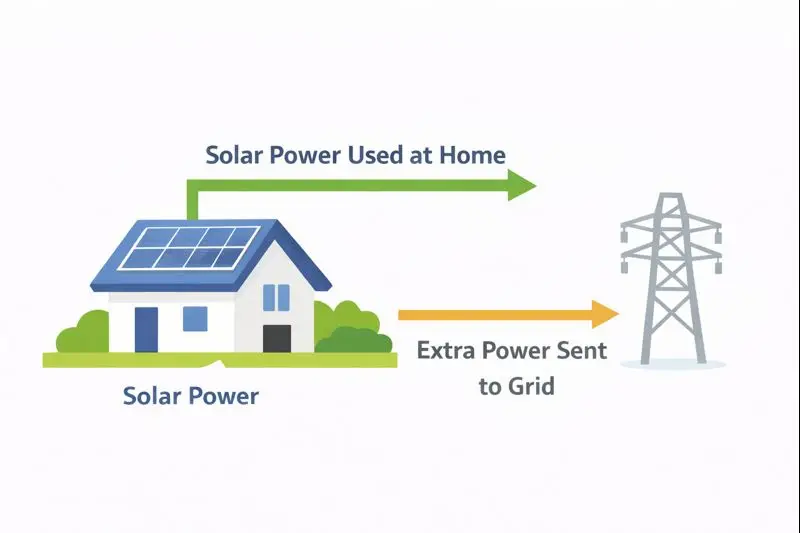
Net metering is a billing system for grid-connected solar. Your home or building stays linked to the power grid. Your solar panels make electricity in the day. Your home uses that power first. When your panels make more than you need, the extra power goes to the grid.
A special meter tracks:
- Electricity you take from the grid
- The electricity you send to the grid
Your power company uses these numbers to prepare your bill.
Net means the final number after minus.
Why net metering matters for your electricity bill
Net metering can reduce your bill in three main ways.
1) You buy fewer units from the grid
Your solar power runs fans, lights, and appliances in the day. Your meter records fewer imported units. Your bill drops because you buy less grid power.
2) You get credit for extra solar power
Many homes use less power in the afternoon. Solar output stays high during that time. Net metering sends extra power to the grid. Your bill gets a credit for those exported units. Your solar system’s output also depends on the solar power plant’s capacity factor, which indicates how much power your panels actually produce compared to their full rating.
3) It helps in high-bill months
Summer bills rise due to AC use. Solar also produces well in sunny months. Net metering helps you balance those units. Your credit can reduce the pain of peak season bills.
Net metering vs a normal solar system
A basic solar setup can still save money. But net metering adds more value.
Solar without net metering (simple view)
- Your home uses solar power in the day
- Extra solar may go unused if your system blocks export
- You still pay full price for nighttime grid use
Solar with net metering (simple view)
- Your home uses solar power first
- Extra solar goes to the grid
- You get bill credit for exported units
- You pay only for net units (import minus export)
How net metering works step by step
Here is the flow in daily life.
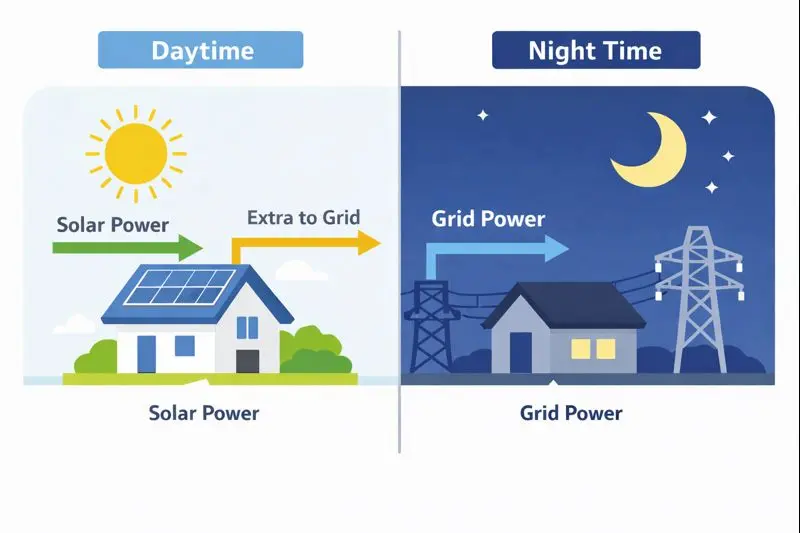
During the day
- Solar panels make electricity.
- Your home uses it first.
- Extra power goes to the grid.
- The meter records exported units.
At night or on cloudy hours
- Solar output drops.
- Your home takes power from the grid.
- The meter records imported units.
At billing time
Your DISCOM checks both readings.
They subtract export from import.
They charge you based on the net result.
What is a net meter?
A net meter is a two-way meter. People also call it a bi-directional meter. It measures:
- Import (grid to home)
- Export (home to grid)
It works like a scorekeeper. It shows how much you used. It also shows how much you shared.
Who can use net metering in India?
Many users can apply. Rules can differ by state and DISCOM.
Common eligible users include:
- Homes with rooftop solar
- Small shops and offices
- Schools and clinics
- Housing societies (in many areas)
- Some factories (based on local limits)
Your system must connect to the grid. Off-grid solar does not use net metering. Off-grid solar uses batteries and stays separate from the grid.
Net metering rules in India: what changes by state
India has net metering in many states. But each state sets its own rules. Your DISCOM also sets its own process.
These points often vary:
- Maximum solar system size allowed
- Type of connection allowed (single phase or three phase)
- Meter type and meter cost
- Billing cycle rules for carry-forward credits
- Extra charges like fixed charges or meter rent
- Paperwork and approval steps
So you should always check your local DISCOM rules before you buy panels.
What is a DISCOM?
DISCOM means distribution company. It is your electricity supply company. It sends your monthly bill. It also manages net metering approvals in most areas.
You will deal with your DISCOM for:
- Application and documents
- Site inspection
- Meter change
- Final approval and connection
A simple example: how net metering changes your bill
Let’s use a simple example. Numbers can change by tariff and state. This example shows the idea.
Example home usage
- Your home uses 400 units in a month.
- Your solar system makes 350 units in that month.
- Your home uses 250 units of solar power directly.
- Your home exports 100 units to the grid.
- Your home imports 150 units from the grid at night and other times.
What the meter shows
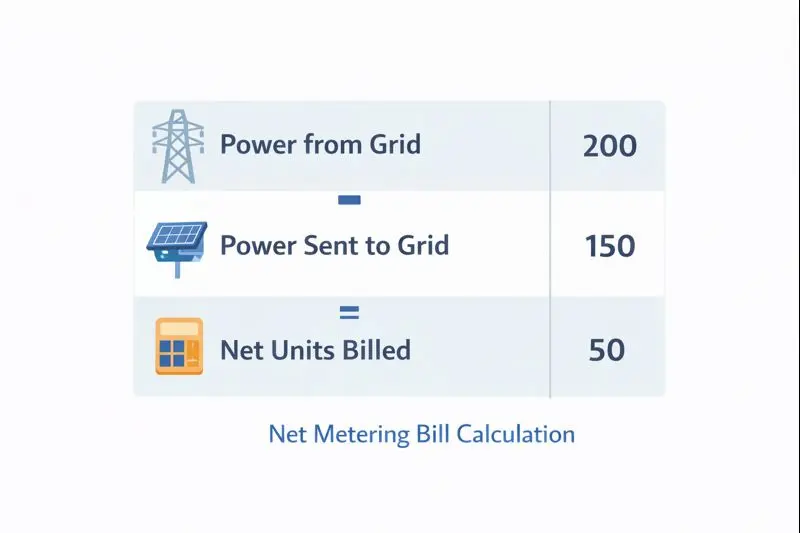
- Import from grid: 150 units
- Export to grid: 100 units
- Net units: 150 – 100 = 50 units
Your bill charges you mainly for 50 units, not 400 units.
You may still pay:
- Fixed charges
- Meter charges
- Taxes and duties (as per your state)
But your energy charge drops a lot.
What you need for net metering
You usually need these items.
1) A grid-connected solar system
Your solar inverter must support grid connection. It must match DISCOM safety rules.
2) A net meter
Your DISCOM installs or approves this meter.
3) DISCOM approval
Your DISCOM must approve the system. They may inspect wiring and safety items.
4) Proper documents
Most DISCOMs ask for basic papers.
Common documents include:
- Latest electricity bill
- ID proof and address proof
- Connection details (load, meter number)
- Solar system details (capacity, inverter type)
- Installer documents (if required)
How to apply for net metering in India
The exact steps change by DISCOM. The flow usually looks like this.
Step 1: Check your roof and your load
You should check:
- Roof space and shade
- Your monthly unit use
- Your sanctioned load (shown on your bill)
Step 2: Choose your solar system size
Most homes pick a size based on the bill and roof. Before choosing a system, check the solar panel dimensions and sizes to confirm that your roof has sufficient space for net metering.
A simple thumb rule:
- Higher bill = larger system (if roof space allows)
- Daytime use helps you save more
A good installer can suggest the right size.
Step 3: Apply to your DISCOM
You submit an online or offline net metering application. You attach your documents.
Step 4: Install the solar system (as allowed)
Some DISCOMs allow installation after approval only. Some allow it after initial approval. Follow your local rule.
Step 5: Inspection and meter change
Your DISCOM team checks:
- Wiring and earthing
- Inverter and safety setup
- Labels and shut-down switches (if required)
They install the net meter after approval.
Step 6: Start generating and tracking credits
After the net meter goes live, your export starts. Your bill starts showing import, export, and net units.
How much money can net metering save?
Savings depend on:
- Your tariff per unit
- Your solar system size
- Your daytime use pattern
- Sunlight in your city
- Your roof shade and direction
Net metering helps most when:
- Your system makes extra power in the day
- Your home imports power at night
- Your DISCOM gives full credit for exported units (as per local rules)
A home with steady daytime loads can see faster savings. A home that stays empty in the day can still save because export earns credits.
What charges can still appear on your bill?
Net metering reduces the energy part of the bill. But some charges can remain.
You may still see:
- Fixed charges (based on connection type)
- Demand charges (common in some non-home users)
- Meter rent or service charges
- Taxes and duties
So your bill may not become zero. But it can drop a lot.
Net metering vs gross metering in India
Some states offer gross metering for some users. This is different from net metering.
Net metering
- You use solar power in your home first
- You export only extra power
- Your bill reduces through net units
Gross metering
- You export all solar power to the grid
- You buy all your home power from the grid
- The DISCOM pays you a set rate for solar export (as per policy)
Net metering fits many homes. Gross metering may suit some users based on local rates. Your installer can explain which option your DISCOM allows.
Common mistakes people make
Avoid these issues to get better results.
1) Picking the wrong system size
A very small system gives low savings. A very large system may face export limits. You should match the size with your bill and local rules.
2) Ignoring shade
Shade reduces output. Trees, water tanks, and nearby buildings can cut power. You should check the shade before you finalise.
3) Buying cheap parts with poor support
Solar parts run for many years. You should buy quality panels and a reliable inverter. You should also check the warranty and service.
4) Skipping paperwork
Net metering needs approvals. You should follow the DISCOM process. You should keep all documents ready.
Tips to get more savings with net metering
Use these easy tips.
Shift heavy use to daytime
You should run heavy loads when the sun is strong. This reduces grid import.
Examples:
- Washing machine
- Iron
- Water pump
- Dishwasher
- AC in the afternoon (if needed)
Keep panels clean
Dust reduces output. You should clean panels on a safe schedule. You should follow safety rules and use proper tools.
Track your monthly report
You should check:
- Import units
- Export units
- Net units
- Credit carry-forward (if your DISCOM allows it)
This helps you spot problems early.
Use energy-efficient appliances
Efficient fans, lights, and ACs reduce your load. Solar then covers a bigger share of your use.
Is net metering good for apartments and societies?
It can work in many places. Rules can vary.
Possible options include:
- A common rooftop system for common areas
- A shared system with sub-metering (if allowed)
- Separate systems for each flat (rare and complex)
A society should speak to the DISCOM early. A society should also check roof rights and the sharing rules.
How long does approval take?
Time depends on the DISCOM and city. Some areas process faster. Some take longer due to inspections and meter stock.
You can speed things up with:
- Complete documents
- A certified installer
- Correct wiring and safety setup
- Quick reply to DISCOM queries
Safety and quality checks you should demand
A safe solar system protects your family and your home. Ask your installer for:
- Proper earthing
- DC and AC isolators (shut-off switches)
- Surge protection (as required)
- Strong mounting structure
- Safe cable routing and conduit
- Clear labels near switches and meters
A good installer explains each item in simple words.
FAQs: Net metering in India
Here is a list of important questions about the topic.
Net metering is a billing system for rooftop solar. It lets you use solar power first and export extra power to the grid. A net meter records import and export units. Your bill is reduced based on net units.
Yes. Net metering reduces the units you buy from the grid. It also gives bill credit for extra solar units you export. This lowers the total bill in many homes.
A net meter is a two-way meter. It records the power you take from the grid and the power you send to the grid. The DISCOM uses this data to calculate net units.
No. Net metering works with a grid-connected solar system. The grid acts as a backup at night. Batteries are optional and cost more.
Most grid-tied solar systems stop during a power cut. This protects line workers. A hybrid system with backup can supply power if it includes the right setup.
Your local DISCOM approves net metering. The DISCOM checks documents and safety items. It also installs or approves the net meter.
Most DISCOMs ask for your latest electricity bill, ID proof, and system details. Some also ask for an installer form and wiring diagram. Rules can change by state.
Net metering lets you use solar power in your home first. Gross metering sends all solar power to the grid and pays you a set rate. Your DISCOM policy decides which option you can use.
Quick checklist before you buy rooftop solar
Use this checklist.
- I checked my roof shade and space
- I checked my monthly units on the bill
- I checked my sanctioned load
- I confirmed the net metering rules with my DISCOM
- I picked a trusted installer with warranty support
- I asked for safety items and proper earthing
- I understood the fixed charges on my bill
Final take: why net metering matters
Net metering helps you get more value from rooftop solar. It lowers your grid use. It also gives credit for extra solar power. This can cut your monthly bill in a clear and trackable way.
If you plan a solar system in India, you should check the net metering rules first. You should also pick a good installer. These two steps protect your money and your results.





- Be Respectful
- Stay Relevant
- Stay Positive
- True Feedback
- Encourage Discussion
- Avoid Spamming
- No Fake News
- Don't Copy-Paste
- No Personal Attacks
- Be Respectful
- Stay Relevant
- Stay Positive
- True Feedback
- Encourage Discussion
- Avoid Spamming
- No Fake News
- Don't Copy-Paste
- No Personal Attacks
